Good sleep doesn’t usually depend on one perfect habit. Instead, it’s often the result of small daily routines that work together to support healthy sleep over time.
This collection of habits is known as sleep hygiene. Despite the name, it has nothing to do with cleanliness. Sleep hygiene refers to everyday behaviors and environmental factors that may help create the right conditions for better sleep.
While healthy sleep habits can’t guarantee a perfect night’s sleep, research suggests they may support better sleep quality when practiced consistently. The key is focusing on realistic routines rather than searching for a quick fix.
What Is Sleep Hygiene?
Sleep hygiene is the term used to describe habits that support healthy, consistent sleep.
These habits include maintaining a regular sleep schedule, creating a comfortable bedroom environment, developing a relaxing bedtime routine, and making lifestyle choices that encourage restful sleep.
Rather than relying on a single strategy, sleep hygiene emphasizes that small behaviors practiced consistently may have a greater impact than making occasional dramatic changes.
Many healthcare organizations recommend healthy sleep habits as a first step in supporting better sleep because they’re simple, practical, and generally easy to incorporate into everyday life.
Why Good Sleep Habits Matter
Many factors influence sleep, including age, lifestyle, stress, health conditions, and everyday routines. While some of these factors are outside our control, our daily habits are one area where small adjustments may make a meaningful difference.
Healthy sleep habits help create an environment that supports your body’s natural sleep process. They also encourage consistency, which many sleep experts consider an important part of maintaining good sleep over time.
It’s important to keep realistic expectations. Sleep hygiene isn’t designed to produce immediate results after a single night. Instead, these habits tend to work best when they become part of a regular routine.
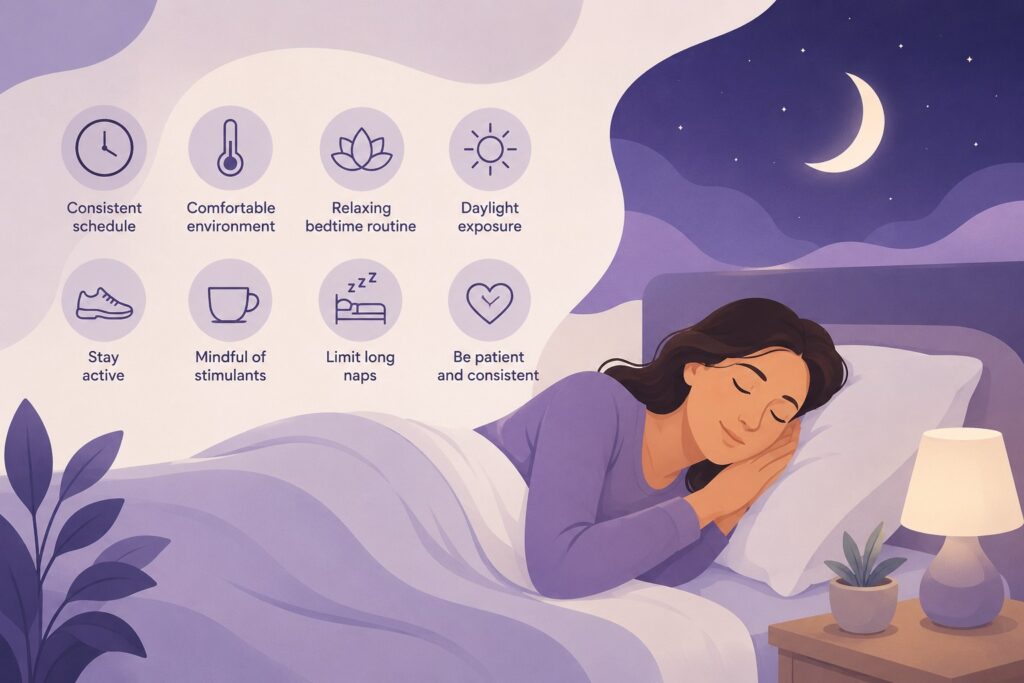
Quick Sleep Hygiene Checklist
Healthy sleep habits don’t have to be complicated. Many experts recommend focusing on a few simple practices that are easy to maintain over time.
- Go to bed and wake up at about the same time each day.
- Keep your bedroom cool, dark, and quiet whenever possible.
- Create a relaxing bedtime routine before going to sleep.
- Limit caffeine later in the day if it affects your sleep.
- Get natural daylight exposure during the day.
- Stay physically active on most days.
- Avoid long or late-afternoon naps if they interfere with nighttime sleep.
- Be patient—healthy sleep habits often take time to become effective.
Think of this checklist as a starting point rather than a set of strict rules. Even adopting one or two new habits may help support better sleep over time.
Keep a Consistent Sleep Schedule
One of the simplest sleep hygiene habits is going to bed and waking up at roughly the same time every day, including weekends whenever possible.
A consistent schedule helps your body develop a predictable sleep pattern. While occasional late nights are part of normal life, maintaining regular sleep and wake times most days of the week may make it easier to establish a healthy routine.
If you’re trying to change your schedule, gradual adjustments often feel more manageable than shifting your bedtime by several hours all at once.
Create a Comfortable Sleep Environment
Your bedroom plays an important role in supporting restful sleep.
Many people sleep best in a room that is cool, dark, and quiet. Comfortable bedding and minimizing unnecessary light or noise may also contribute to a more relaxing sleep environment.
You don’t need to create a perfect bedroom overnight. Even small improvements—such as reducing light from electronic devices or adjusting the room temperature to a comfortable level—can make your sleep environment feel more inviting.
Build a Relaxing Evening Routine
The hour before bedtime can help signal to your body that it’s time to wind down. Creating a calming evening routine doesn’t have to be complicated—it simply means choosing activities that help you transition from a busy day to a more restful state.
Reading a book, listening to quiet music, practicing gentle stretching, or taking a warm bath are all examples of relaxing bedtime habits that many people enjoy.
If you find that certain evening habits make it harder to fall asleep—such as using electronic devices for long periods, drinking caffeinated beverages late in the day, or eating large meals shortly before bed—you may benefit from making small adjustments over time. The goal isn’t perfection but consistency.
Get Natural Light During the Day
Natural daylight plays an important role in supporting a healthy sleep-wake cycle.
Spending time outdoors during the morning or early afternoon may help reinforce your body’s natural daily rhythm and make it easier to feel sleepy at night.
Even if you spend much of the day indoors, opening curtains, sitting near a window, or taking a short walk outside can increase your exposure to natural light.
Stay Physically Active
Regular physical activity supports overall health and may also contribute to better sleep for many people.
You don’t need an intense workout routine to experience these benefits. Activities such as walking, gardening, cycling, swimming, or strength training can all be part of an active lifestyle.
The most important factor is finding activities you enjoy and can maintain consistently. A sustainable routine is often more valuable than occasional bursts of intense exercise.
Limit Long or Late-Day Naps
A short daytime nap can be refreshing for some people, especially after a poor night’s sleep.
However, long naps or naps taken late in the afternoon may make it more difficult to fall asleep at your usual bedtime.
If you enjoy napping, keeping it relatively brief and earlier in the day may help reduce the chance of interfering with nighttime sleep.
Be Patient With New Habits
One of the biggest misconceptions about sleep hygiene is that it should produce immediate results.
In reality, healthy sleep habits often work gradually. Your body may need time to adjust to a more consistent routine, particularly if your sleep schedule has been irregular for a long period.
Rather than changing everything at once, consider introducing one or two new habits at a time. Small, sustainable changes are often easier to maintain than trying to completely overhaul your routine overnight.
Remember that occasional restless nights are a normal part of life. They don’t necessarily mean your sleep habits aren’t working.
When Healthy Sleep Habits May Not Be Enough
Sleep hygiene can support better sleep, but it isn’t a solution for every sleep concern.
If you’ve consistently practiced healthy sleep habits and continue to experience persistent sleep difficulties, frequent nighttime awakenings, or ongoing daytime fatigue, it may be helpful to explore the underlying cause.
You may also find these Bloomelle guides helpful if you’re looking for information about specific sleep concerns:
- Why Sleep Changes After 40 — explains how normal aging can influence sleep patterns.
- Why Am I Waking Up in the Middle of the Night? — explores common reasons for nighttime awakenings.
- Why Is It Harder to Fall Asleep After 40? — discusses factors that may contribute to difficulty falling asleep.
- Why Is My Sleep Lighter After 50? — explains why sleep may feel less restorative with age.
- Why Do I Wake Up Feeling Tired Even After Sleeping? — looks at why you may still feel tired despite spending enough time in bed.
Conclusion
Sleep hygiene isn’t about following a long list of rules or achieving perfect sleep every night. It’s about creating everyday habits that support healthy, consistent sleep over time.
Simple practices—such as maintaining a regular sleep schedule, creating a comfortable bedroom, developing a relaxing bedtime routine, getting daylight exposure, staying active, and being patient with new habits—may all contribute to better sleep quality.
Not every strategy works the same way for everyone, and occasional restless nights are completely normal. The goal is progress, not perfection. By focusing on small, sustainable habits, you can build a routine that supports healthy sleep as part of your overall well-being.
References
- American Academy of Sleep Medicine (AASM). Healthy Sleep Habits. https://sleepeducation.org/healthy-sleep/
- Centers for Disease Control and Prevention (CDC). Sleep and Sleep Disorders. https://www.cdc.gov/sleep/
- National Institute on Aging (NIA). A Good Night’s Sleep. https://www.nia.nih.gov/health/sleep
- National Heart, Lung, and Blood Institute (NHLBI). Sleep Deprivation and Deficiency. https://www.nhlbi.nih.gov/health/sleep-deprivation
- National Sleep Foundation. Sleep Hygiene. https://www.thensf.org/
- Irish LA, Kline CE, Gunn HE, Buysse DJ, Hall MH. The role of sleep hygiene in promoting public health: A review of empirical evidence. Sleep Medicine Reviews. 2015;22:23–36. https://doi.org/10.1016/j.smrv.2014.10.001
- American Academy of Sleep Medicine. Recommended amount of sleep for a healthy adult: A joint consensus statement of the American Academy of Sleep Medicine and Sleep Research Society. Journal of Clinical Sleep Medicine. 2015;11(6):591–592. https://doi.org/10.5664/jcsm.4758
- National Institutes of Health (NIH) – MedlinePlus. Sleep. https://medlineplus.gov/sleep.html